1.5 - Examination Structure and Universal Certification
Regulatory and provider verification date: August 5, 2026
Primary authority: Current EPA Section 608 certification requirements, test-topic guidance, and approved-certification-program listings
Provider-specific example: SkillCat online testing information current as of the verification date
Course role: Explains how the Section 608 examination is organized, how certification is earned, and how students should prepare for a secure Universal examination
Learning Objectives
After completing this section, a student should be able to:
- Explain why a Section 608 examination must be administered by an EPA-approved certifying organization.
- Distinguish EPA approval of a certification test from approval of a commercial training course or study guide.
- Describe the relationship among Core, Type I, Type II, Type III, and Universal certification.
- Explain why Core must be passed to receive an equipment-specific certification.
- Explain why an open-book Core result cannot be used to obtain Universal certification.
- Distinguish limited Type I testing options from the secure, proctored requirements used for Universal certification.
- Describe the common 25-question-per-section examination structure used by many approved programs.
- Explain why passing scores, time limits, retake policies, allowed materials, and credential-delivery procedures must be verified with the selected provider.
- Prepare an appropriate physical or online testing environment.
- Apply effective multiple-choice reading, pacing, checking, and error-management strategies.
- Explain what happens after certification is earned and why the credential should be preserved.
- Evaluate readiness separately for Core, Type I, Type II, and Type III.
Introduction
EPA does not certify a technician merely because the technician completes a training course, reads a study guide, or has field experience. A person must pass an EPA-approved Section 608 certification test administered by an EPA-approved certifying organization.
The examination is organized around four knowledge areas:
- Core
- Type I
- Type II
- Type III
Universal certification is earned by successfully completing the required Core, Type I, Type II, and Type III examination sections under the applicable secure and proctored conditions.
The examination is not intended to test advanced engineering analysis. It primarily tests whether a candidate can:
- Recognize the correct federal requirement.
- Classify equipment correctly.
- Select an appropriate recovery or service procedure.
- Identify safe and unsafe practices.
- Interpret important pressure, evacuation, recovery, and refrigerant-handling conditions.
- Distinguish similar technical and regulatory terms.
- Read a multiple-choice question carefully.
This project prepares students to understand the material rather than memorize isolated answer letters. The actual certification examination must still be taken through a currently approved organization.
Key Concepts
1. The Test Must Be EPA Approved
EPA requires technicians to pass an EPA-approved test to earn Section 608 certification.
The test must be administered by an organization appearing on EPA’s current list of approved Section 608 certification programs.
Approved organizations may offer:
- In-person testing.
- Testing at schools or training centers.
- Testing through employers or unions.
- Remote proctored testing.
- Online-only testing.
- Limited Type I mail-in or non-proctored options where permitted.
The availability of a testing format does not mean that every format can be used for every certification level.
2. EPA Approves Testing Organizations, Not Commercial Study Materials
EPA maintains a list of organizations approved to administer Section 608 certification tests.
EPA states that it does not review or approve commercial:
- Training courses.
- Preparatory programs.
- Study manuals.
- Practice examinations.
- Videos.
- Mobile applications.
- Flashcards.
- Private teaching materials.
Therefore, statements such as the following must be interpreted carefully:
- “EPA-approved test provider” can be accurate.
- “EPA-approved study guide” may be misleading unless it refers specifically to materials incorporated into an approved testing program.
- “Official EPA practice questions” should not be claimed unless the source is genuinely EPA-issued.
This project is an independent teaching and certification-preparation resource. It is not itself an EPA-approved testing program.
3. The Four Examination Sections
The standard examination framework uses four sections.
| Examination Section | Primary Knowledge Area | Certification Role |
|---|---|---|
| Core | Environmental effects, regulations, refrigerant handling, recovery fundamentals, safety, cylinders, and related common knowledge | Required foundation for equipment-specific certification |
| Type I | Small appliances | Used with Core to earn Type I certification |
| Type II | Medium-, high-, and very-high-pressure appliances | Used with Core to earn Type II certification |
| Type III | Low-pressure appliances | Used with Core to earn Type III certification |
Core is common to all certification types.
It is not a separate equipment authorization by itself.
4. How Limited Certifications Are Earned
A candidate may seek one or more limited certifications.
The common relationship is:
| Sections Successfully Completed | Certification Earned |
|---|---|
| Core + Type I | Type I |
| Core + Type II | Type II |
| Core + Type III | Type III |
| Core + Type I + Type II | Type I and Type II |
| Core + Type I + Type III | Type I and Type III |
| Core + Type II + Type III | Type II and Type III |
| Core + Type I + Type II + Type III | Universal |
Passing an equipment-specific section without satisfying the applicable Core requirement does not provide the completed certification.
A candidate is not required to attempt every equipment-specific section during the same study period or test session unless the selected provider’s product is structured that way.
5. Universal Certification
Universal certification covers the appliance categories included under:
- Type I.
- Type II.
- Type III.
Universal is not a separate fourth equipment category.
To earn Universal certification, the candidate must successfully complete all required examination sections under secure, closed-book, proctored conditions accepted by the EPA-approved certifying organization.
The required knowledge includes:
- Core environmental and regulatory material.
- Type I small-appliance material.
- Type II medium-, high-, and very-high-pressure appliance material.
- Type III low-pressure appliance material.
6. The Open-Book Core Limitation
EPA states that a Core examination taken as an open-book examination cannot be used to obtain Universal certification.
The Core examination must be taken as a proctored examination for Universal certification.
This rule is especially important when considering limited Type I testing options.
Some approved programs offer Type I testing that is:
- Mail-in.
- Non-proctored.
- Open-book.
- Otherwise administered differently from a secure Universal examination.
Such an option may provide a limited Type I pathway when administered by an approved program, but it does not automatically create a Core result usable toward Universal certification.
A student who intends to earn Universal certification should take the complete required examination through a secure, proctored pathway from the beginning.
7. Common Question Structure
The popular project study guides and many approved providers use the following common structure:
| Examination | Common Question Structure |
|---|---|
| Core | 25 questions |
| Type I | 25 questions |
| Type II | 25 questions |
| Type III | 25 questions |
| Universal | 100 total questions |
A limited examination commonly combines:
- 25 Core questions.
- 25 questions from the selected certification type.
For example:
| Limited Examination | Common Total |
|---|---|
| Type I | 50 questions |
| Type II | 50 questions |
| Type III | 50 questions |
This structure is widely used, but students must confirm the exact format with their selected certifying organization before testing.
8. Passing Score and Section Credit
Many Section 608 programs and study guides use a nominal passing requirement of approximately 70 percent, commonly expressed as at least 18 correct answers out of 25 for an individual section.
However, the exact scoring language must be confirmed with the selected provider.
This is especially important because public provider information may differ in wording.
For example, SkillCat’s public pages currently contain two different descriptions:
- Its FAQ describes a 70 percent total requirement for the selected examination.
- A separate current SkillCat guide describes passing each section with at least 18 correct answers out of 25.
Because the public descriptions are not fully consistent, the candidate should follow the instructions displayed in the current SkillCat application and examination agreement at the time of testing.
For this project, the preparation standard is intentionally higher:
Readiness target: at least 22 correct answers out of 25 in Core, Type I, Type II, and Type III on two separate closed-book practice attempts.
This is an 88 percent readiness target for each section.
The higher target provides protection against:
- Question wording differences.
- Test anxiety.
- Memory errors.
- Misreading.
- Weakness in one certification section.
- Changes in the provider’s question mix.
9. Each Section Must Be Treated as a Separate Knowledge Area
A high overall score can hide a serious weakness.
For example, a candidate could perform well in Core and Type I but poorly in Type III.
Therefore, this course tracks four separate scores:
| Section | Readiness Score |
|---|---|
| Core | ___ / 25 |
| Type I | ___ / 25 |
| Type II | ___ / 25 |
| Type III | ___ / 25 |
The candidate should not rely only on a combined percentage.
10. Examination Questions Are Multiple Choice
Section 608 certification tests use multiple-choice questions.
A question commonly contains:
- One stem.
- Four answer choices.
- One best answer.
Question types include:
- Definitions.
- Equipment classification.
- Refrigerant classification.
- Regulatory requirements.
- Recovery procedures.
- Evacuation levels.
- Safety.
- Cylinder handling.
- Leak detection.
- Pressure-temperature interpretation.
- Scenario analysis.
- Numerical thresholds.
- Sequence questions.
The actual test questions are drawn from approved examination banks and may be worded differently from this project’s practice questions.
11. Test Topics Are Defined by EPA
EPA publishes the official topic framework for:
- Core.
- Type I.
- Type II.
- Type III.
The topic list identifies the subjects candidates are expected to know.
The topic list is not a complete textbook. It does not necessarily provide:
- Full explanations.
- Worked examples.
- All definitions in teaching order.
- Practice questions.
- Detailed answer rationales.
This project expands the EPA topic framework into a complete learning sequence.
12. Approved Organizations May Use Different Delivery Procedures
EPA approval confirms that the organization may administer the certification test.
It does not mean all organizations use identical:
- Registration systems.
- Prices.
- Time limits.
- Retake policies.
- Waiting periods.
- Identification procedures.
- Online-proctoring software.
- Credential-delivery methods.
- Physical-card fees.
- Language options.
- Test-site rules.
A candidate must read the selected provider’s current instructions before the examination.
13. In-Person and Remote Proctoring
A secure examination may be proctored:
- In person.
- Remotely through a computer.
- Remotely through a mobile device when supported by the provider.
A proctoring system may:
- Verify identity.
- Record the candidate’s face.
- Record the screen.
- Monitor the testing area.
- Detect access to unauthorized materials.
- Review the recording after submission.
- Reject an attempt that violates the rules.
Remote testing is valid only when offered by an organization currently approved to administer the Section 608 test.
14. Closed-Book Examination Conduct
For a secure closed-book examination, the candidate should expect that the following are prohibited unless the current provider explicitly permits them:
- Notes.
- Study guides.
- Textbooks.
- Internet searches.
- Messaging another person.
- Receiving assistance.
- Screenshots or recording.
- Copying questions.
- Using another electronic device.
- Leaving the monitored area without permission.
The provider controls whether any of the following are supplied or permitted:
- Calculator.
- Pressure-temperature chart.
- Scratch paper.
- On-screen reference material.
- Breaks.
- Headphones.
- External monitor.
- Mobile phone.
Many closed-book providers permit a pressure-temperature chart and calculator, but students must verify the current selected provider’s rules rather than assume the same materials are allowed everywhere.
15. Credential Validity
EPA states that Section 608 technician-certification credentials do not expire.
This means:
- No federal expiration date is attached to the credential.
- A technician does not routinely retake the examination to renew the credential.
- The credential remains valid even if the original certifying organization later stops testing.
However:
- Regulations may change.
- Safety classifications may change.
- Refrigerants and equipment may change.
- State or local licenses may have renewal requirements.
- Employer qualifications may require continuing training.
Lifetime certification does not mean lifetime technical currency.
16. Preserve the Certification Record
EPA does not issue individual Section 608 certification cards and cannot ordinarily replace a card directly.
The approved certifying organization:
- Issues the credential.
- Maintains a record of the credential.
- Handles verification or replacement while it remains in operation.
A technician should retain:
- Digital certificate.
- Certificate number.
- Physical card, if obtained.
- Testing-organization name.
- Examination date.
- A secure backup copy.
- A copy supplied to the employer when appropriate.
If the credential is lost and no acceptable record can be located, the technician may have to retake the examination.
SkillCat Online Examination Example
1. Why SkillCat Is Included as an Example
EPA’s current approved-program list identifies SkillCat as:
- An approved Section 608 certification program.
- Approved on November 18, 2020.
- An online-testing-only provider.
- A provider offering Spanish availability.
The current EPA list, rather than an advertisement, should be used to confirm approval status before registration.
2. Current SkillCat Public Examination Structure
SkillCat’s current FAQ describes:
| SkillCat Examination | Questions | Time Limit |
|---|---|---|
| Type I | 25 Core + 25 Type I | 1 hour |
| Type II | 25 Core + 25 Type II | 1 hour |
| Type III | 25 Core + 25 Type III | 1 hour |
| Universal | 25 Core + 25 Type I + 25 Type II + 25 Type III | 2 hours |
SkillCat states that the sections may be mixed together in the examination display rather than presented as four visibly separated blocks.
3. Current SkillCat Proctoring Information
SkillCat’s current FAQ states:
- Universal, Type II, and Type III examinations are proctored.
- The proctoring software records the candidate’s face and screen.
- External notes, outside help, and internet searching are prohibited.
- Type I is described as non-proctored.
- A submitted Universal, Type II, or Type III attempt may require up to approximately 48 hours for review.
Candidates should read the current in-app examination instructions because software and review procedures can change.
4. Current SkillCat Retake Information
SkillCat’s current public information states:
- Four attempts are available.
- A waiting period of approximately 4 hours applies between attempts.
These are SkillCat program policies, not permanent federal rules for every provider.
5. Current SkillCat Credential Information
SkillCat currently states:
- A digital certificate remains available in the account after certification.
- Membership cancellation does not cancel an earned certification.
- A physical card is optional and carries a separate fee.
- The certificate number is used as the EPA code within the SkillCat system.
Students should save the digital certificate immediately after approval.
6. SkillCat Information That Must Be Rechecked
Before taking the SkillCat examination, recheck:
- Current subscription price.
- Free-trial conditions.
- Number of included attempts.
- Waiting period.
- Time limit.
- Passing-score method.
- Proctoring rules.
- Required identification.
- Device requirements.
- Certificate-review time.
- Physical-card fee.
- Language options.
Provider information can change without changing the federal certification itself.
Examination Preparation Procedure
Step 1 — Select the Intended Certification
For the widest stationary-equipment scope, select Universal preparation.
Universal is normally the most efficient goal for a student who expects to work with:
- Small appliances.
- Residential and commercial HVAC.
- Commercial refrigeration.
- Low-pressure chillers.
Step 2 — Select a Currently Approved Provider
Use EPA’s current approved-program list.
Confirm:
- The organization is still approved.
- It offers the desired certification.
- It offers the desired delivery method.
- Its online or test-site requirements are practical.
- Its retake and card policies are acceptable.
Step 3 — Read the Current Candidate Instructions
Do not depend on an old study guide for:
- Time limit.
- Allowed materials.
- Passing score.
- Retake waiting period.
- Identification.
- Proctoring technology.
- Device requirements.
- Credential-delivery time.
Step 4 — Complete Section-by-Section Preparation
Prepare and assess:
- Core.
- Type I.
- Type II.
- Type III.
Do not postpone Type III because it is less familiar. Its procedures differ significantly from Type II.
Step 5 — Complete Closed-Book Practice
Practice under realistic conditions:
- No notes.
- No internet.
- No answer key.
- Timed session.
- Quiet room.
- One sitting.
- Four-choice questions.
- Section score recorded separately.
Step 6 — Review Every Missed or Guessed Question
For each uncertain question, record:
- Tested section.
- Topic.
- Selected answer.
- Correct answer.
- Why the selected answer was wrong.
- Why the correct answer is right.
- Whether the error came from outdated information.
- Whether the question was misread.
- Which course file should be reviewed.
Step 7 — Meet the Readiness Standard
Before the official Universal attempt, achieve at least:
| Section | Required Practice Target |
|---|---|
| Core | 22 / 25 |
| Type I | 22 / 25 |
| Type II | 22 / 25 |
| Type III | 22 / 25 |
Meet the target on two separate cumulative practice attempts.
Step 8 — Prepare the Testing Environment
For remote proctoring:
- Use a supported device.
- Use a stable internet connection.
- Charge the device or connect it to power.
- Confirm camera and microphone operation.
- Close unnecessary applications.
- Silence notifications.
- Use a quiet, private room.
- Remove notes and unauthorized materials.
- Prepare acceptable identification.
- Allow time for identity verification and instructions.
Step 9 — Preserve the Credential
After passing:
- Download the digital certificate.
- Record the certificate number.
- Save a secure backup.
- Print a copy.
- Request a physical card if useful.
- Record the issuing organization.
- Provide proof to the employer when required.
Examination Strategy
1. Read the Complete Question
Do not answer from the first familiar word.
Read:
- The complete stem.
- Every answer choice.
- Any condition or exception.
- The requested direction, such as
most likelyorfirst.
2. Identify the Tested Category
Before selecting an answer, ask:
- Is this Core?
- Is this Type I?
- Is this Type II?
- Is this Type III?
- Is this Section 609 rather than Section 608?
Correct classification often eliminates several distractors.
3. Identify the Controlling Condition
Common controlling conditions include:
- Appliance type.
- Refrigerant pressure category.
- Charge size.
- Equipment manufacture date.
- Recovery-equipment manufacture date.
- Functional or nonfunctional compressor.
- Major or non-major repair.
- Service versus disposal.
- Ozone-depleting refrigerant versus substitute.
- Before or after a regulatory date.
- Closed-book versus open-book test status.
4. Mark High-Risk Words
Pay special attention to:
- Not
- Except
- Minimum
- Maximum
- First
- Last
- Most
- Least
- Required
- Prohibited
- Before
- After
- Always
- Never
A candidate may know the technical content and still miss the question by overlooking one of these words.
5. Eliminate Distractors Systematically
A distractor may be:
- Correct for a different certification type.
- Correct under an older regulation.
- Correct for a different refrigerant.
- Correct only when the compressor is operating.
- Correct only for equipment made before or after a date.
- A good practice but not the required answer.
- A minimum value confused with a maximum.
- A Section 609 rule placed in a Section 608 question.
6. Manage Time
Using a 100-question, 2-hour example:
- Total time = 120 minutes.
- Average time per question = 1.2 minutes.
- This is approximately 72 seconds per question.
A practical pacing method is:
- Answer straightforward questions promptly.
- Mark uncertain questions.
- Avoid spending excessive time on one item.
- Return to marked questions.
- Reserve time to review
not,except, and numerical questions.
The selected provider’s actual time limit controls.
7. Do Not Change an Answer Without a Reason
Change an answer only when:
- A missed condition is identified.
- A regulatory distinction is recognized.
- A calculation is corrected.
- Another answer is clearly more accurate.
- The original selection resulted from misreading.
Do not change an answer solely because of nervousness.
8. Avoid Test Misconduct
Do not:
- Copy examination questions.
- Photograph the screen.
- Search online.
- Use hidden notes.
- Receive help.
- Discuss secure questions during the examination.
- Attempt to defeat proctoring software.
A provider may invalidate the attempt and refuse certification.
Important Terms
Approved Certifying Organization
An approved certifying organization is an organization authorized by EPA to administer the Section 608 technician-certification test and issue certification credentials.
Closed-Book Examination
A closed-book examination prohibits use of unauthorized notes, books, internet resources, or outside assistance.
Core
Core is the common knowledge examination section required as the foundation for Section 608 equipment-specific certification.
Credential
A credential is the certificate, card, certification number, or other record showing successful Section 608 certification.
Limited Certification
A limited certification authorizes covered work only within one or more successfully completed equipment-specific categories rather than all three types.
Proctor
A proctor is a person or approved monitoring system that supervises an examination, verifies identity, and protects test security.
Remote Proctoring
Remote proctoring uses a camera, microphone, screen recording, or related technology to supervise an examination away from a physical test center.
Universal Certification
Universal certification is the combined Section 608 certification covering Type I, Type II, and Type III appliance categories.
Figures and Diagrams
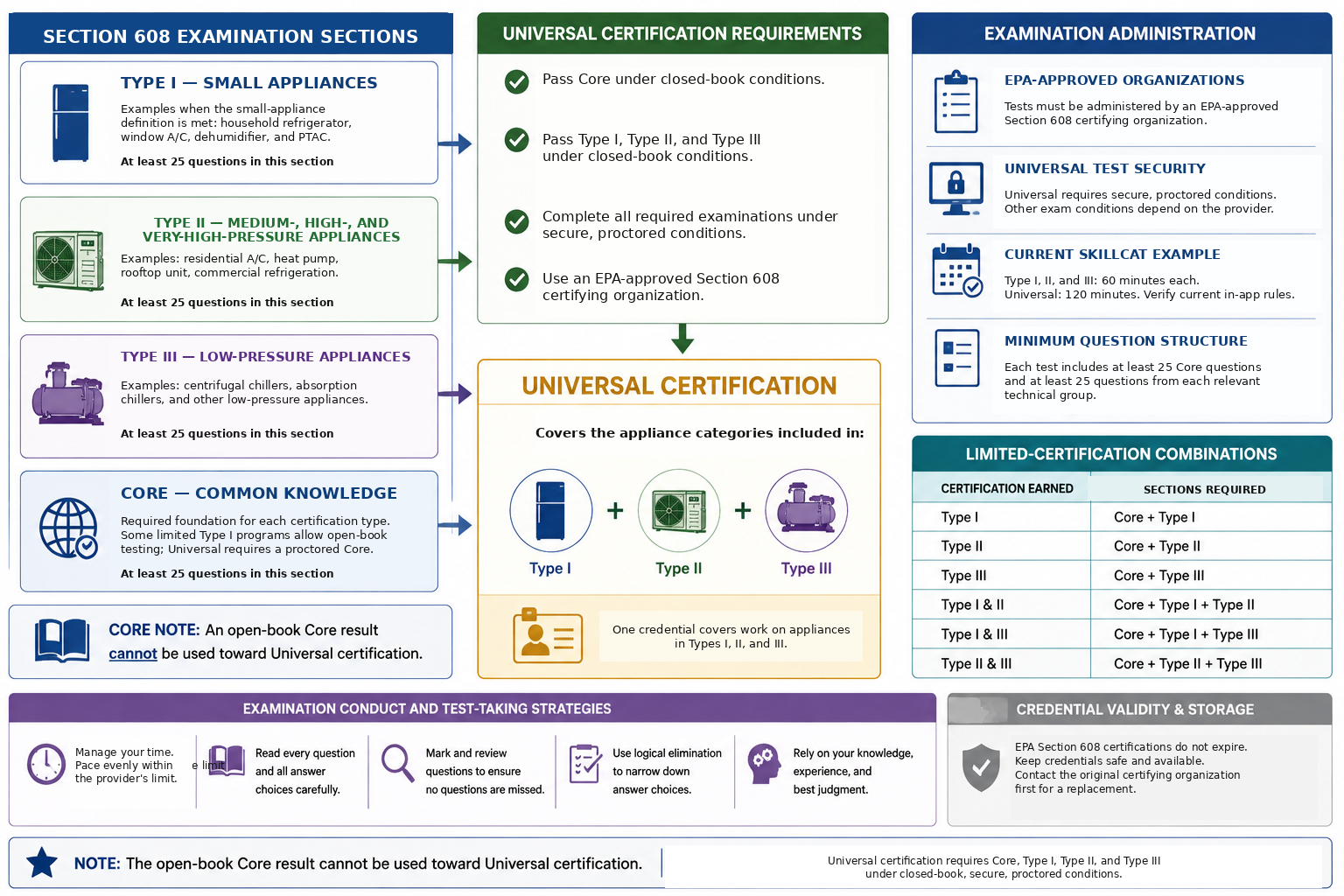
Figure 1.5.1 – Examination sections and pathways to limited or Universal Section 608 certification.
AI-generated instructional figure: It may contain visual inaccuracies. Use the accompanying lesson text and cited authoritative sources to verify technical and regulatory details.
EPA 608 Exam Focus
What Students Must Remember
- The test must be administered by an EPA-approved certifying organization.
- EPA approves testing organizations; it does not approve ordinary commercial preparation materials.
- Core is required as the common foundation for equipment-specific certification.
- Core alone is not an equipment authorization.
- Type I requires Core plus Type I.
- Type II requires Core plus Type II.
- Type III requires Core plus Type III.
- Universal requires Core, Type I, Type II, and Type III.
- Universal is not a separate equipment category.
- An open-book Core result cannot be used to obtain Universal certification.
- Universal requires a secure, proctored examination pathway.
- Many programs use 25 questions per section.
- Exact scoring and provider procedures must be verified before testing.
- Section 608 credentials do not expire.
- EPA does not directly issue or ordinarily replace individual certification cards.
- The original certifying organization should be recorded and the credential preserved.
- Remote online testing is valid only when offered by a currently approved organization.
- Provider policies are not permanent federal rules and can change.
Typical Exam Question Patterns
Students may be asked to identify:
- Who may administer the Section 608 examination.
- Which sections must be passed for a certification.
- Whether Core alone authorizes service.
- Whether an open-book Core result can count toward Universal.
- Which certification results from passing Core and selected type sections.
- Whether certification credentials expire.
- Whether EPA directly issues replacement cards.
- The difference between provider policy and federal certification requirements.
- Why a candidate should verify allowed materials.
- Which test-reading word changes the meaning of a question.
High-Priority Examination Table
| Goal | Required Examination Sections |
|---|---|
| Type I | Core + Type I |
| Type II | Core + Type II |
| Type III | Core + Type III |
| Type I and Type II | Core + Type I + Type II |
| Type I and Type III | Core + Type I + Type III |
| Type II and Type III | Core + Type II + Type III |
| Universal | Core + Type I + Type II + Type III |
Common Mistakes and Confusing Points
Mistake 1: Assuming Course Completion Creates Certification
Training supports preparation, but the candidate must pass an approved test.
Mistake 2: Assuming Any Online Test Is Valid
The test must be administered by a currently EPA-approved certification organization.
Mistake 3: Treating Core as a Stand-Alone Equipment Certification
Core must be combined with at least one equipment-specific section.
Mistake 4: Using an Open-Book Core Result for Universal
EPA states that an open-book Core test cannot be used to obtain Universal certification.
Mistake 5: Assuming All Providers Use Identical Rules
Question order, time limits, retakes, allowed materials, and credential procedures can differ.
Mistake 6: Assuming a 70 Percent Overall Score Guarantees Every Certification
Scoring language and section-credit rules must be verified with the provider. Preparation should be evaluated section by section.
Mistake 7: Preparing Only for the Familiar Sections
Students with residential HVAC experience may neglect Type III. Universal requires all four knowledge areas.
Mistake 8: Memorizing Answer Letters
The real examination may use different wording, order, and distractors.
Mistake 9: Ignoring Not or Except
A candidate can know the technical fact and still select the opposite answer.
Mistake 10: Failing to Preserve the Credential
If no acceptable record can be found later, retesting may be required.
Concept-Check Questions
Question 1
Who must administer a valid Section 608 certification test?
A. Any HVAC employer
B. Any licensed professional engineer
C. An EPA-approved Section 608 certifying organization
D. Any refrigerant manufacturer
Question 2
Which statement about EPA approval is correct?
A. EPA approves every commercial Section 608 study guide
B. EPA approves certifying organizations that administer the test
C. EPA requires students to purchase an EPA-authored textbook
D. EPA approves only in-person examinations
Question 3
Which examination sections are required for Type II certification?
A. Core and Type II
B. Type I and Type II
C. Core and Type III
D. Type II only
Question 4
Which combination produces Universal certification?
A. Core and any one type section
B. Type I, Type II, and Type III without Core
C. Core, Type I, Type II, and Type III
D. Core and Section 609
Question 5
Which statement about an open-book Core examination is correct?
A. It may always be used for Universal certification
B. It cannot be used to obtain Universal certification
C. It replaces the Type I examination
D. It provides Type II certification by itself
Question 6
Which statement about the Section 608 credential is correct?
A. It expires every 5 years
B. It must be renewed annually through EPA
C. It does not expire, but technicians must still follow current requirements
D. It becomes invalid when the testing provider changes its prices
Question 7
Why should a candidate verify the selected provider’s current instructions?
A. EPA allows every provider to change federal appliance definitions
B. Time limits, retake rules, allowed materials, and credential procedures may differ
C. The Clean Air Act applies differently in every testing room
D. Only the provider decides whether venting is legal
Question 8
A student scores 24 out of 25 in Core but 15 out of 25 in Type III on a practice examination. What is the best conclusion?
A. The high Core score proves complete Universal readiness
B. The student should identify Type III as a weak section and remediate it
C. The Type III result can be ignored if the combined score exceeds 70 percent
D. The student should stop practicing because Core is the only required section
Question 9
Which word in an examination stem most directly signals that the candidate must identify an exception?
A. Typical
B. Except
C. Common
D. Appliance
Question 10
What is the best action immediately after receiving a digital Section 608 certificate?
A. Delete the email because EPA maintains every individual card
B. Save the certificate number and multiple backup copies
C. Retake the exam annually
D. Post the secure test questions online
Answers and detailed explanations will be provided in
1.9 - Answers and Explanations.md.
Section Summary
Section 608 certification is earned by passing an EPA-approved test administered by an EPA-approved certifying organization.
The examination framework includes:
- Core.
- Type I.
- Type II.
- Type III.
Core is the common foundation but is not an equipment authorization by itself.
The certification relationships are:
- Core + Type I → Type I.
- Core + Type II → Type II.
- Core + Type III → Type III.
- Core + Types I, II, and III → Universal.
An open-book Core result cannot be used to obtain Universal certification. Universal requires the complete required examination under a secure, proctored pathway.
Many programs use 25 questions per section, producing a 100-question Universal examination. Exact scoring, time limits, retake policies, allowed materials, and credential procedures must be confirmed with the selected provider.
For this project, the candidate should achieve at least 22 out of 25 in each section on two separate closed-book practice attempts before taking the official Universal examination.
The next section develops a structured study method, readiness tracker, and error log for reaching that standard.
References
Current Regulatory and EPA Sources
-
U.S. Environmental Protection Agency, Section 608 Technician Certification, accessed August 5, 2026.
-
U.S. Environmental Protection Agency, Section 608 Technician Certification Requirements, accessed August 5, 2026.
-
U.S. Environmental Protection Agency, Certification Programs for Section 608 Technicians, accessed August 5, 2026.
-
U.S. Environmental Protection Agency, Section 608 Test Topics, accessed August 5, 2026.
-
U.S. Environmental Protection Agency, Steps for Replacing a Lost Section 608 Technician Certification Card, accessed August 5, 2026.
-
Electronic Code of Federal Regulations, 40 CFR Part 82, Subpart F — Recycling and Emissions Reduction, accessed August 5, 2026.
-
Electronic Code of Federal Regulations, 40 CFR § 82.161 — Technician Certification, accessed August 5, 2026.
Current Provider-Specific Sources
-
SkillCat, Frequently Asked Questions, accessed August 5, 2026.
-
SkillCat, Online EPA 608 Certification, accessed August 5, 2026.
-
SkillCat, SkillCat EPA 608 Online Certification Guide, accessed August 5, 2026.
-
SkillCat Support, How Long Does Someone Need to Wait to Take the EPA 608 Exam Again?, accessed August 5, 2026.